PHOTOGRAMMETRY · HERITAGE RECORDING
Using Photogrammetry to Preserve South Australia's Oldest Known Colonial Fishing Boat
Alexei Tiong · Originally published 25 March 2024 on LinkedIn ↗
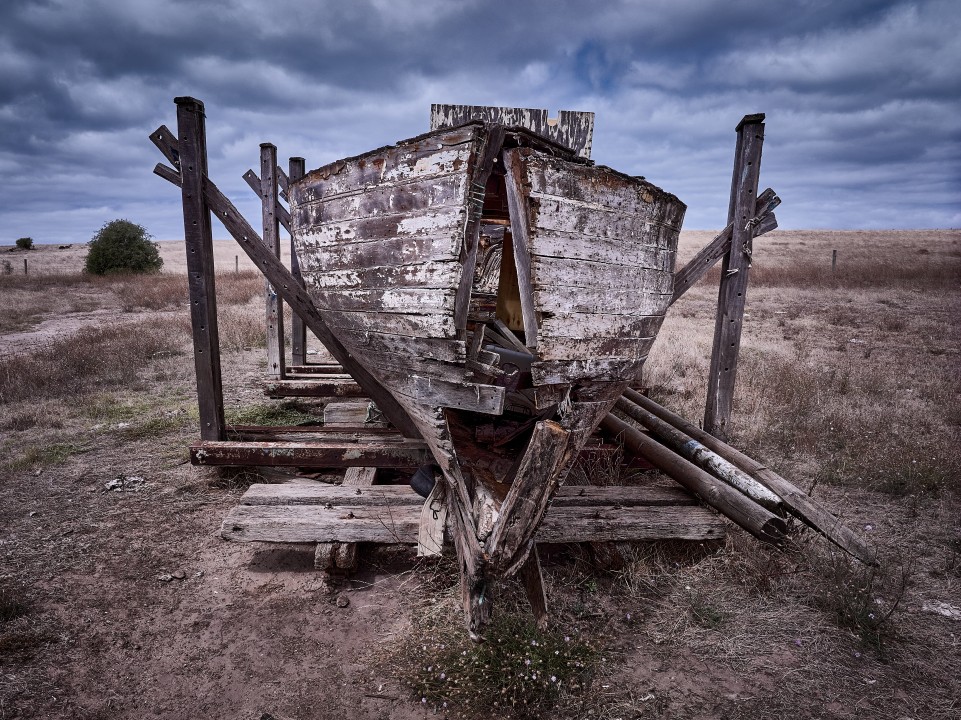
The Rambler boat, built back in 1878, is possibly the oldest surviving fishing vessels in South Australia. After a long productive life, serving as a fishing vessel, a racing yacht, and a transport delivering mail between Victor Harbor and Kangaroo Island. The Rambler is now in its final resting place, located in a paddock in Waitpinga, Victor Harbor. Although it has been proposed, preservation of this heritage vessel is highly unlikely. The boat is now deteriorating fast and it has been estimated that the Rambler boat may only survive for another 5 to 10 years.
Preserving the Rambler using Photogrammetry.
In March 2023, I was given access to the area, where I was able to photograph the entire boat using a drone and a standard mirrorless digital camera. I have always been interested in using photogrammetry for heritage preservation purposes. So, this was perhaps the final opportunity for me to create a 3D model of the Rambler, where it can then live in the digital world forever.
To read more about the Rambler, view this article from the ABC.
Collecting the Data.
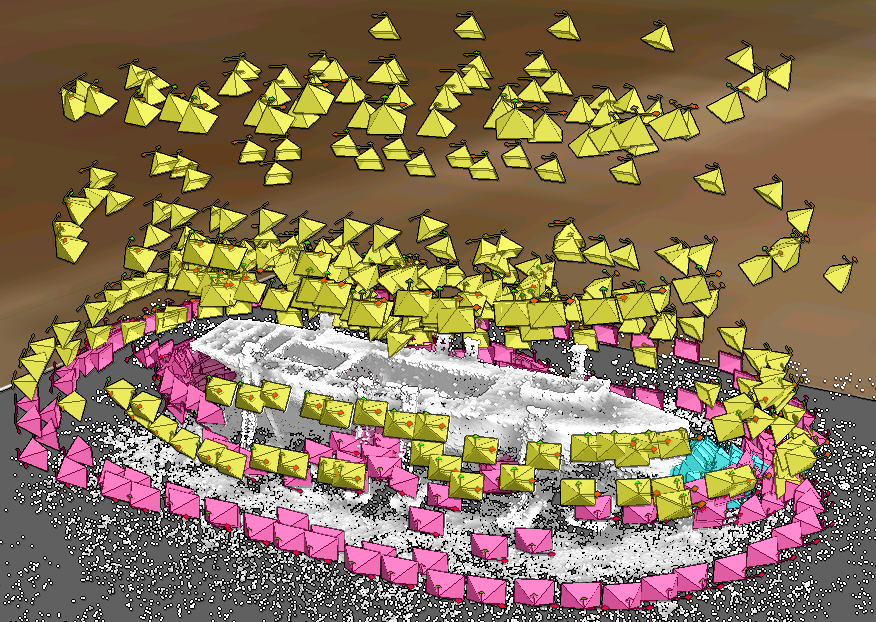
To create the 3D model of the Rambler, 561 images where collected. The boat had to be photographed from as many angles as possible, from both the ground and the air. To collect the terrestrial images (coloured pink and blue in figure 1), I used the Sony A6400 mirrorless camera (APS-C sensor), with a 24mm prime lens (Sony Zeiss 24mm f/1.8). The aerial images (coloured yellow in figure 1) were collected using the DJI Mavic 3, which uses the 4/3 CMOS Hasselblad sensor.
The timelapse video (figure 2) below shows all the images that were collected. On the day of the flight, wind speeds were quite strong, which made the aerial photography much more challenging. It can be seen in the timelapse video that the drone appears to be getting blown around in the wind.
Processing the RAW Imagery.
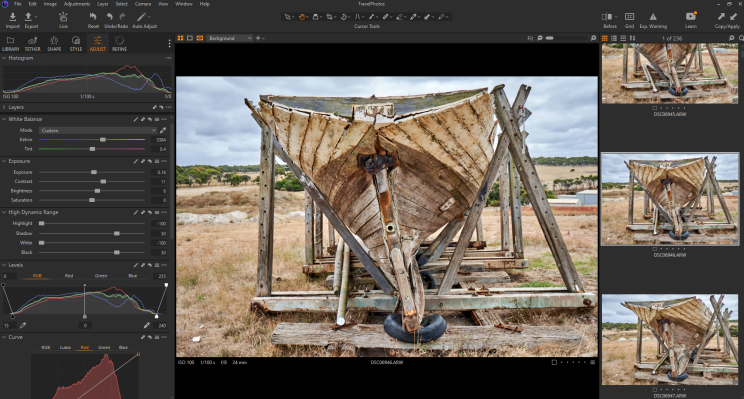
All the photographs were collected in a RAW format. Using the CaptureOne editing software, the image histograms were adjusted to correct for the differences in colour profiles from the two difference camera sensors (figure 3).
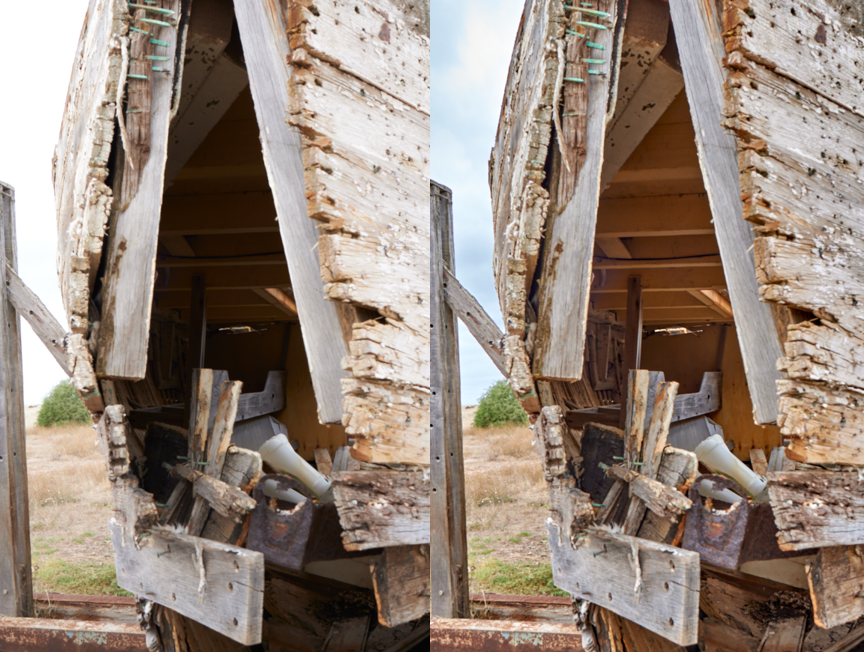
In addition to matching the colour profiles between the aerial and terrestrial images, highlights were reduced and shadows were recovered (figure 4). This is the prime advantage of using RAW imagery, rather than the compressed JPEG format straight from the camera.
Processing the 3D model using Photogrammetry software.
To create the 3D model, Skyline's PhotoMesh software was used (figure 5). The PhotoMesh software is unique in the way that the reconstruction AOI can be dynamically split into tiles, based on reconstruction complexity. This allows the creation of very high detailed models, on any computer hardware.
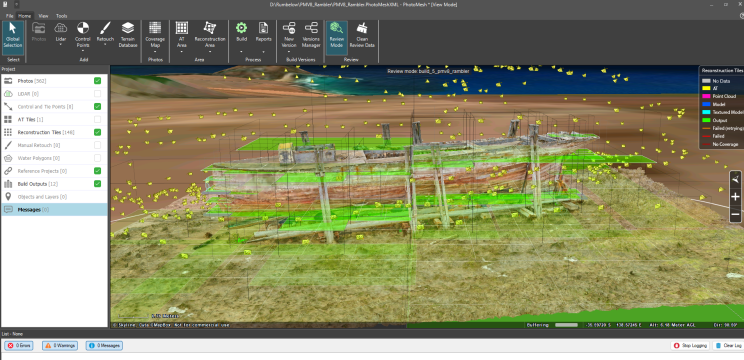
Using the highest processing settings on a single laptop computer, the reconstruction (148 tiles), image aero triangulation and model output, took nearly 24 hours to complete in total. Optionally, the processing of all the reconstruction tiles could have been divided between multiple computers to reduce processing time.
The single computer used to create the model was an AORUS 7A K1 gaming laptop, which uses the AMD Ryzen 9 5900HX 8-core processor, 64GB RAM and the NVIDIA GeForce RTX 3070 Laptop GPU. All data was stored and processed on local fast SSD drives.
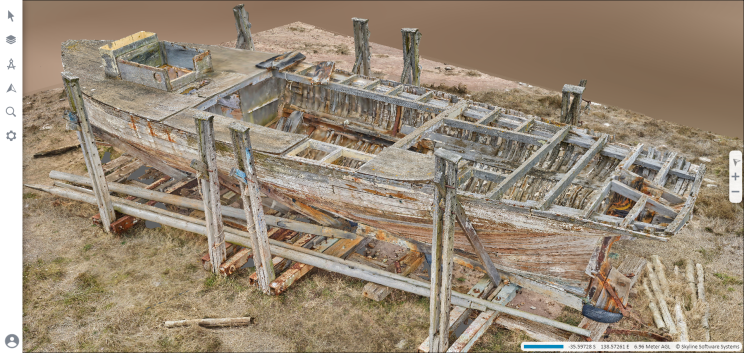
The video shown below (figure 6), is a render of the resulting 3D model, and was created using Skylines TerraExplorer (3D visualisation software). The output is in a 3DML format (that is similar to the Cesium 3D Tiles), which contains multiple LODs (levels of detail), to allow smooth and fast rendering in a web or desktop client.
Sharing the data.
To share the data through to the web client, as shown in the web application below, a server side application called SkylineGlobe Server was used to host and stream both the web application and the 3D mesh data.
To view the Rambler boat model, click this TerraExplorer Fusion link, or the image below (figure 6).
Access to the data.
If you would like access to the RAW data to perform your own testing, feel free to reach out to me.
If you have any questions you can contact me here on LinkedIn or email me at ationg@skylinesoft.com.